






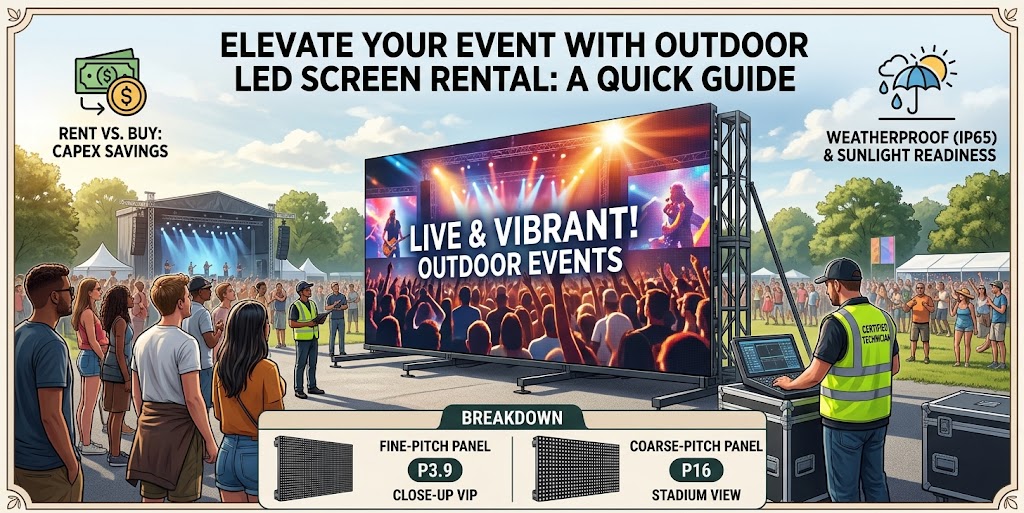
An outdoor LED screen rental brings your event to life with a massive, high-impact digital display, all without the six-figure price tag of ownership. It’s the go-to solution for event organizers needing to blow away large crowds at concerts, festivals, or corporate functions with vibrant visuals that pop, even in direct sunlight.
Why an Outdoor LED Screen Rental Makes Sense
Think of it this way: if you’re a professional photographer hired for a single, high-stakes photoshoot, would you buy a $50,000 camera system you might only use once or twice? Of course not. You’d rent the absolute best gear available, get incredible results, and return it when you’re done. The same logic applies perfectly to renting a giant outdoor LED screen.
Purchasing a large-format LED display is a massive capital investment, often running into tens or even hundreds of thousands of dollars. For most organizations, that’s just not practical for a one-off or annual event. Renting completely sidesteps this financial hurdle.
The Financial Advantage of Renting
The most obvious benefit is the immediate cost savings. You avoid the huge upfront price of the hardware. But the savings go much deeper than that. Ownership is loaded with hidden expenses that renting eliminates entirely:
- No Maintenance Costs: You aren’t on the hook for repairs, pixel replacement, or any technical upkeep.
- No Storage or Insurance Fees: You don’t have to find a warehouse to store a giant screen or pay to insure it year-round.
- No Depreciation Worries: LED technology moves fast. Renting means you always get modern, high-performance equipment without owning an expensive asset that’s losing value by the day.
For event organizers, renting can slash capital costs by up to 70% compared to purchasing. This is a smart financial move that frees up your budget for other critical event needs, like booking better talent, boosting marketing, or enhancing the attendee experience.
The Logistical Edge and Market Momentum
Beyond the money, renting gives you an unbeatable logistical advantage. A professional outdoor LED screen rental company handles the heavy lifting—literally. They manage transportation, setup by certified technicians, on-site operation during the event, and teardown afterward. This full-service approach removes a massive operational headache and drastically reduces the risk of technical glitches.
This isn’t just a niche preference; it’s where the entire industry is heading. The global LED screen rental market is on track to hit USD 385 million by 2033, with outdoor screens dominating a huge 50% market share. This explosive growth is driven by large-scale performances and sports events, which accounted for over 60% of all rental demand in the first half of 2026 alone. These numbers show a clear industry-wide shift toward flexible, high-impact rental solutions. You can discover more about these market trends and their implications for the event industry to see where things are headed.
Making Sense of Your LED Screen’s Tech Specs
When you start looking into an outdoor LED screen rental, it can feel like you’re suddenly learning a new language. Vendors throw around terms like “pixel pitch,” “nits,” and “refresh rates,” but don’t get intimidated. Understanding these core specs is what gives you the power to choose the right screen for your event.
Getting these details right is the difference between a blurry, washed-out display and a brilliant, sharp visual experience that absolutely wows your audience. These specs aren’t just jargon; they’re the critical factors that determine a screen’s performance, cost, and whether it’s even suitable for your venue. A screen that looks amazing at a nighttime concert might be totally useless at a sunny daytime festival. Let’s get into what really matters.
What Is Pixel Pitch and Why Does It Matter?
Pixel pitch is simply the distance, measured in millimeters (mm), between the center of one tiny LED pixel and the center of the next one. The easiest way to think about it is like the dots in a newspaper photo—the closer the dots, the sharper and more detailed the image looks up close.
A small pixel pitch number (like 3.9mm) means the pixels are packed tightly together. This creates a high-resolution image that stays crisp even when people are standing just a few feet away. It’s the perfect choice for trade show booths, corporate events, or any VIP area where your audience is up close and personal with the screen.
On the other hand, a larger pixel pitch (like 10mm or more) is more than enough for big venues like stadiums, large concerts, or roadside displays where the audience is hundreds of feet back. From that distance, the human eye naturally blends the pixels together, and the image appears perfectly seamless.
Key Takeaway: The best pixel pitch is always tied to your audience’s viewing distance. Choosing a pitch that’s too big for a close-up event will look blocky and unprofessional. But spending extra on a super-fine pitch when your audience is far away is just a waste of money.
To make it even simpler, here’s a quick guide to help you match the right pixel pitch to your event’s specific needs.
Matching Pixel Pitch to Your Event’s Viewing Distance
| Pixel Pitch (mm) | Minimum Viewing Distance (Meters/Feet) | Optimal Viewing Distance (Meters/Feet) | Common Event Application |
|---|---|---|---|
| P2.9 – P3.9 | 3m / 10ft | 5-15m / 16-50ft | Trade shows, indoor corporate events, VIP sections |
| P4 – P6 | 4m / 13ft | 10-30m / 33-100ft | Festivals, small concerts, sporting event sidelines |
| P8 – P10 | 8m / 26ft | 20-60m / 65-200ft | Large concerts, stadium displays, drive-in movies |
| P12 – P16 | 12m / 40ft | 30m+ / 100ft+ | Highway billboards, massive stadium scoreboard screens |
Use this table as your starting point. It’s a fast way to narrow down what you need before you even start talking to vendors.
Brightness and Refresh Rate
Two other specs you absolutely need to know are brightness and refresh rate. These directly control how well your content is seen, especially when dealing with tough lighting conditions or fast-moving video.
-
Brightness (Nits): This measures how much light the screen blasts out. For any outdoor LED screen rental, this is a dealbreaker. To stand up to direct sunlight, you need a screen with a brightness of at least 5,000 nits. Anything less is going to look dim, washed out, and completely lost during the day.
-
Refresh Rate (Hz): This number tells you how many times per second the image on the screen is redrawn. A standard screen might run at 1920Hz, but if you’re broadcasting live sports or showing fast-action video, you need 3840Hz or higher. This is crucial for preventing motion blur and that annoying flicker you see when a camera records a screen.
This concept map helps visualize how all these technical details fit into the bigger picture of planning your event.
As you can see, a successful rental is a balance between the budget, the logistics, and the audience experience you want to create. Getting the tech specs right is the foundation for all three.
Matching Specs to Your Event
Once you have a handle on these details, you can have a much more productive conversation with a rental provider. You can go from saying “I need a big screen” to confidently specifying your actual requirements, making sure you get the right gear without overspending. For a deeper dive into the different kinds of displays available, you can explore our full range of LED screens and see how their specs fit different applications.
For example, a marathon finish line needs a screen with high brightness to be seen in the middle of the day and a high refresh rate to capture runners crossing the line without any blur. A small community food festival, however, could get great results with a more affordable mobile screen that has a moderate pixel pitch, since the crowd will be fairly close. When you know what to ask for, you guarantee your investment delivers the biggest possible impact.
Choosing the Right Type of Outdoor LED Display
Once you’ve got a handle on the technical specs, the next big decision for your outdoor LED screen rental is picking the right physical format. Not all screens are created equal, and the type you choose directly impacts setup time, cost, and the entire feel of your event. It’s all about matching the hardware to the job at hand.
Think of it like choosing a vehicle. You wouldn’t use a sports car to haul lumber, and you wouldn’t drive a semi-truck down a narrow city alley. The same logic applies here—the screen’s form factor has to fit your event’s scale, location, and creative goals.
Mobile LED Trailers: The Speed and Simplicity Option
For events that need to get up and running fast with zero fuss, mobile LED trailers are the undisputed champion. These are self-contained units where the screen is built right onto a truck or trailer. The whole system—screen, hydraulic lift, and often a generator and sound system—rolls right into place.
An experienced operator can have a mobile screen up, running, and ready for your content in under 30 minutes. This makes them a perfect fit for:
- Roadshows and multi-city marketing tours
- Community festivals and parades
- Marathon finish lines and local sporting events
- Pop-up drive-in movies
The biggest advantage is pure speed. You completely sidestep the complex rigging and panel-by-panel construction needed for other screen types. You can see just how mobile LED trailers offer a complete solution for these kinds of fast-paced events. The main trade-off? You’re typically limited to standard screen sizes and aspect ratios, like 16:9.
Modular LED Walls: The Customization Powerhouse
When your creative vision calls for a massive visual backdrop or a totally unique shape, modular LED walls are the way to go. These systems are built on-site by locking individual LED panels together like building blocks. This approach opens the door to almost limitless customization.
You can create massive, seamless video walls for concert stages, wrap screens around corners, build towering vertical pillars, or even construct displays with dramatic curves. This incredible flexibility is why they’re the standard for large-scale productions where visual impact is everything, like stadium tours, major product launches, and televised award shows.
But all that customization comes with more complex logistics. A modular setup requires a skilled crew, structural engineering and rigging, and a lot more time compared to a mobile trailer. The cost is also higher to account for the extra labor and specialized equipment involved.
The new generation of modular rental systems is a game-changer for the events industry. These modern panels can be assembled up to 50% faster than older, more cumbersome rigging methods, making them a powerful tool even for productions with tight schedules.
Innovative and Specialty LED Displays
Beyond the two main workhorses, a few specialty screen types have popped up to solve unique creative problems and open new doors for engaging an audience.
-
Transparent LED Film: This incredible tech lets you turn almost any glass surface—like a retail storefront or the side of a modern office building—into a see-through video display. It’s perfect for retail advertising or architectural designs where you want to show video content without completely blocking the view from inside.
-
COB (Chip-on-Board) Panels: COB is a newer manufacturing process that results in tougher, more weather-resistant LED panels. They deliver superior image quality with more consistent color and are far less prone to damage from bumps or moisture, making them a premium option for high-stakes outdoor events.
The market for outdoor displays is booming, with LED screens dominating the rental scene. They now make up 35% of the outdoor advertising LED market, and sports venues alone account for another 20% share. As the U.S. market continues to grow toward an estimated $5.2 billion by 2026, the versatility of these different display types will only drive more adoption across every kind of event.
How to Budget for Your Outdoor LED Screen Rental
Trying to set a budget for an outdoor LED screen rental can feel like you’re aiming at a moving target. The final price tag is a lot more than just a simple daily rate—it’s a complete package that includes the screen technology, the length of your event, and the level of service you need. The key to accurate planning and avoiding surprises is to think about the total investment, not just the hardware.
When a rental company sends you a quote, it’s built from several core parts. If you understand what these parts are, you can see exactly what you’re paying for and find places to adjust the specs to hit your budget.
The Major Cost Drivers Explained
Your rental cost isn’t a single line item but a sum of its parts. The biggest factors are the screen’s physical size, its technical specs, and all the logistics required to get it on-site and running perfectly.
- Screen Size and Pixel Pitch: This is almost always the biggest chunk of the cost. A larger screen needs more LED panels, which drives the price up. In the same way, a screen with a finer pixel pitch (like a crisp P3.9mm) is more expensive to rent than a standard-definition one (like a P10mm) because the underlying technology is more complex and valuable.
- Rental Duration: Most rental pricing is front-loaded. The first day costs the most because it covers the heavy lifting of setup and teardown. Any additional days are usually billed at a much lower rate, which makes multi-day events far more cost-effective on a per-day basis.
- Service Level and Labor: A full-service rental means the pros handle everything: delivery, setup, on-site technical support during your event, and breakdown. The complexity of the job—like building a huge modular video wall versus simply parking a mobile trailer—directly impacts the labor costs.
When you’re budgeting, treat the first quote as your starting point. A typical rental for a medium-sized screen might run from $3,500 to $6,000 for a one-day event, but this can easily change based on your specific needs.
From Core Costs to Hidden Expenses
Beyond the screen itself, a few other elements can sneak up on you if you’re not prepared. Factoring these in from the start will help you build a much more realistic financial plan for your outdoor LED screen rental.
Think about these additional items:
- Delivery and Logistics: How far is your venue from the rental company’s warehouse? That distance affects transportation fees. If your location is remote or has tricky access points, expect those charges to be higher.
- Power Generation: Some mobile screens have their own generators, but most larger or modular displays don’t. You’ll likely need to budget for an external generator, especially if your event is in an open field or park without enough on-site power.
- Permits and Insurance: Your city or county might require special event permits, so be sure to check. Your rental partner should carry their own liability insurance, but it’s always smart to ask exactly what their policy covers and if you need any additional event insurance.
To give you a clearer picture of how these different factors come together, we’ve broken them down in the table below.
What Drives Your LED Screen Rental Costs
This breakdown shows the different factors that influence your total rental price, helping you anticipate costs more accurately.
| Cost Factor | Description | Impact on Budget (Low/Medium/High) |
|---|---|---|
| Screen Size | The total square footage of the display. | High |
| Pixel Pitch | The density of pixels (LEDs); lower numbers mean higher resolution. | High |
| Rental Duration | The number of days the screen is needed for the event. | Medium |
| Labor & Setup | The complexity of installation (e.g., ground-supported vs. flown). | Medium |
| Delivery Distance | The mileage from the warehouse to your venue. | Low-Medium |
| Power Needs | Requirement for external generators vs. using on-site power. | Low-Medium |
| On-Site Tech | Having a dedicated technician present for the entire event. | Medium |
Understanding how these elements add up is crucial. For more on how to package these for the best value, our guide on cost-effective LED video billboards offers some great insights.
By building a budget that accounts for all these variables, you can confidently choose a high-impact display that fits your financial goals and delivers an experience your audience won’t forget.
Your Logistics and Installation Checklist
A brilliant LED display doesn’t just appear out of nowhere. The real work happens long before your guests arrive, turning your great idea for an outdoor led screen rental into a flawless reality. This is where logistics and installation come into play.
Think of it like building a house—if the foundation isn’t solid, the entire structure is at risk. A smooth event day is the direct result of nailing the pre-event checklist, covering everything from site access and power to safety. This is where a full-service provider truly shines, managing these critical details to prevent common on-site disasters.
Site Surveys and Placement Strategy
The very first step is always a detailed site survey. Your rental partner needs to get eyes on the proposed location to spot any potential challenges and confirm it’s suitable for the screen you’ve chosen. This goes way beyond just finding a flat piece of grass.
Key factors evaluated during a site survey include:
- Ground Stability: The team will check if the ground is level and firm enough to support the immense weight of a modular screen or a heavy mobile trailer. Soft, uneven, or sloped ground is a major safety hazard.
- Access Routes: Can a large truck or trailer actually get to the setup spot? The survey identifies any narrow gates, low-hanging tree branches, or tight turns that could make delivery a nightmare.
- Sunlight Patterns: Where will the sun be during the most important parts of your event? Even the brightest screens look better when they aren’t fighting direct glare, ensuring your audience gets the best view possible.
A professional survey prevents that sinking feeling when you discover on event day that the screen can’t be safely installed where you planned. It’s an absolute must for managing risk.
Permitting and Power Planning
Once the location is confirmed, the next step is sorting out the paperwork and power. Depending on your venue and event type, you might need to get special permits from the city or county. Public events, in particular, often have strict rules that must be handled weeks or even months ahead of time.
Power planning is just as crucial. You can’t just plug a massive LED screen into a standard wall outlet. You have two main options:
- On-Site Power: If your venue has a dedicated power hookup (like a company switch or shore power), your rental provider will need to confirm it provides enough stable amperage for the screen.
- External Generators: For most outdoor events in parks, fields, or parking lots, you’ll need to rent an external generator. Your vendor will calculate the exact power draw to make sure the generator can handle the load without a single hiccup.
It’s crucial to discuss noise levels when booking a generator. For weddings, corporate galas, or film shoots, a “whisper-quiet” generator is a must to avoid a loud engine hum drowning out your event’s audio.
The market for rental LED displays is booming, with experts projecting an increase of USD 11.99 billion through 2032. Outdoor screens command a 50% market share, largely driven by sports and commercial events. Newer options, like lithium-battery powered screens, can even cut energy consumption by up to 40%—a huge factor in logistical planning. You can read the full research on rental LED screen market growth to dig deeper into these trends.
How to Select the Right Rental Partner for Your Event
Choosing the right partner for your outdoor led screen rental is just as critical as picking the right screen. Think of your rental vendor as more than just a supplier; they’re a vital part of your event production team. A great partner means a high-impact, low-stress experience, while the wrong one can quickly turn your event into a logistical mess.
It’s tempting to jump at the cheapest quote, but that decision often comes with hidden costs. You might get stuck with outdated equipment, nonexistent technical support, or last-minute problems that throw your entire event off track. A true professional partner delivers value that goes way beyond the price tag, ensuring your event’s visuals are a home run from start to finish.
Look Beyond the Price Tag
The first step in vetting a potential vendor is to dig into their track record and inventory. A reputable company will be eager to show off its portfolio of past events. Ask to see examples of jobs similar in scale to yours, whether you’re planning a huge music festival, a corporate roadshow, or a local movie night.
This isn’t just about seeing pretty pictures; it’s about confirming their real-world capabilities. You should also ask about the age and quality of their equipment. The LED world moves fast, and you want a partner who invests in modern, reliable screens—not someone trying to pass off tired, decade-old panels.
A vendor’s portfolio is their resume. If they can’t show you successful projects that mirror your needs, it’s a major red flag. This proves they have the experience to handle the unique pressures and requirements of your event type.
Verify Technical Expertise and On-Site Support
A brilliant screen is worthless without the expert technicians who know how to run it. One of the most important questions you can ask is about the on-site support included in your rental package. Will a certified technician be on-site for the entire duration of your event?
Frankly, this is non-negotiable. An on-site tech is your insurance policy against glitches. They handle everything:
- Setup and Teardown: Making sure the screen is installed safely and running perfectly before your first guest arrives.
- Content Management: Helping you load, test, and optimize your video content for flawless playback.
- Live Troubleshooting: Instantly fixing any issue that might pop up, from a loose cable to a power flicker, so your audience never even notices.
Without that dedicated support, you risk having a beautiful but blank screen if a single thing goes wrong. Always confirm that an experienced operator is part of the deal.
Review Contracts and Insurance Thoroughly
Before you sign on the dotted line, take a moment to carefully read the rental agreement and verify their insurance coverage. Any professional company will carry substantial liability insurance to protect everyone—you, them, and the venue—in case of an accident. Don’t be shy; ask for a copy of their certificate of insurance.
The contract itself should spell out all the details with no room for confusion. Make sure it includes:
- The exact equipment being provided.
- The total cost, including all labor, delivery, and any potential fees.
- Payment schedules and deposit requirements.
- The cancellation policy, especially how bad weather is handled.
Getting clarity on these details upfront protects you from nasty surprises and unexpected bills. A partner with a transparent contract and proper insurance is a partner you can trust, letting you focus on what really matters: hosting an amazing event.
Frequently Asked Questions About LED Screen Rentals
Even the most detailed event plan can leave a few lingering questions. When it comes to something as critical as an outdoor LED screen rental, you want to be completely sure you’ve covered all your bases. Here are the clear, straightforward answers to the questions we hear most often from event organizers just like you.
Can I Use an Outdoor LED Screen in Bad Weather?
Yes, you absolutely can. Professional outdoor LED screens are engineered from the ground up to perform in the real world, not just in perfect conditions. They carry an Ingress Protection (IP) rating, with IP65 being a common standard. This rating certifies that the screen’s sensitive electronics are sealed and protected from dust, rain, and even snow.
That said, while the screen itself is weatherproof, the real concern in extreme weather is safety. Always talk to your rental provider about their wind-load limits. High winds can pose a risk to the support structure, and any reputable company will have a strict safety protocol for these situations.
Who Creates the Content for the Screen?
In most rental scenarios, you—the client— is responsible for providing the content. This includes any videos, graphics, sponsor advertisements, or live camera feeds you want to display. Your rental partner’s job is to ensure everything you provide is broadcast flawlessly.
Think of your rental company as the expert cinema projectionist. You’re the director providing the film, and they’re the masters who make sure it looks perfect on the big screen. They’ll give you a detailed spec sheet—covering resolution, file types, and aspect ratio—to guarantee your content is perfectly optimized for their display.
If you’re short on time or resources, many full-service providers also offer content creation and formatting as an add-on service. If you think you might need help designing graphics or editing video, it’s always a good idea to bring this up early in the conversation.
What Happens If There Is a Technical Issue?
This is one of the most important questions you can ask, and the answer is what separates the true professionals from the rest. A top-tier rental company will always include an on-site technician as a non-negotiable part of their service. This expert is dedicated to your event from setup all the way through teardown.
Their only job is to monitor the screen, manage content playback, and instantly fix any technical glitches that pop up. Having that expert on hand provides total peace of mind, letting you focus on your event, not the technology. Before you sign any contract, make sure it explicitly states that a dedicated on-site technician is included.
Ready to captivate your audience with a stunning visual experience? Jumbotron Screens, LLC. delivers high-impact, reliable outdoor LED screen rentals nationwide, complete with expert on-site support to ensure your event is a success. Discover the perfect screen for your needs at https://jumbotron.com.